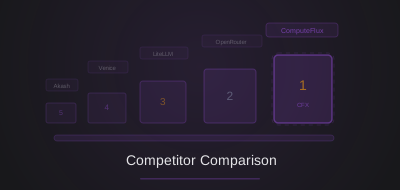
In one sentence. Rather than comparing feature lists, this article asks one question of every product in the category: if the operator turns malicious tomorrow, what actually stops them?
Picture it like this. Choosing a bank by comparing lobby furniture. Every bank has a vault, and every brochure says so. The question that determines whether your money is safe is who can open it, under what conditions, and whether anyone would find out.
Why it matters. A checkmark in a comparison table tells you a feature exists, not that it protects you. If you're evaluating rather than building, start here — and note that the article is genuinely fair to the alternatives, including one case where a competitor's trust story beats ComputeFlux's.
Want the summary of ComputeFlux's own position? Skip to the hybrid approach.
Beyond Feature Checklists
Feature comparison matrices are the industry's favorite way to analyze competitors, and they are almost entirely useless. A checkmark in "TEE Support" tells you nothing about whether the TEE implementation actually protects user data, whether the attestation chain is verifiable, or whether the enclave code has been audited. To understand what differentiates these systems, we must analyze their trust models — who holds what power, what they can do with it, and what prevents them from doing harm. This is the difference between a feature and a guarantee.
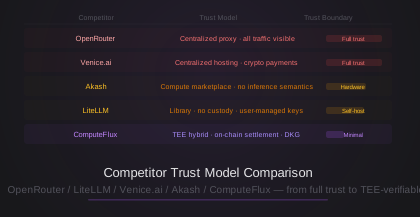
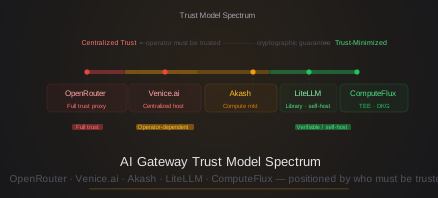
Article 22: Roadmap 2026-2027 laid out where ComputeFlux is headed — epoch automation, DKG bootstrap, full WASM contracts, ZK proofs, and DAO governance. With that trajectory in mind, it's worth asking a harder question: headed there from where, exactly, relative to everyone else building in this space? ComputeFlux (tee-provider) competes in the AI inference routing space against four distinct architectural categories: centralized software proxies (OpenRouter), library-based middleware (LiteLLM), centralized crypto gateways (Venice.ai), and decentralized compute markets (Akash). Each has a fundamentally different answer to the question: "If the operator turns malicious, what protects the user?"
Category 1: OpenRouter — The Centralized Proxy with a Crypto Façade
OpenRouter's architecture is the simplest and, from an adoption standpoint, the most successful. It runs a centralized server that accepts API requests from users, forwards them to upstream providers (OpenAI, Anthropic, etc.), and returns the responses. It adds value through: (a) unified billing across providers, (b) automatic failover when a provider is down, (c) a model discovery interface, and (d) cryptocurrency payment support.
The Trust Model
OpenRouter's trust model is complete centralization with transparency theater. Every request — including the user's prompt, the model's response, and the user's API key for OpenRouter — passes through OpenRouter's servers in plaintext (from the server's perspective; TLS protects the wire). The operator can read every prompt, log every response, and — if they were malicious — exfiltrate the API keys that users trust them to proxy.
None of this is a secret. OpenRouter's privacy policy states plainly that they may log request data. The trust model is "trust us, because our business depends on not abusing this access" — the same model every centralized SaaS product runs on, and it works fine for the vast majority of users who aren't sending sensitive data to AI models.
It's fundamentally incompatible with enterprise work involving PII, medical data, legal documents, or proprietary code. Which is to say, the use cases that would benefit most from AI inference.
The Custody Model
OpenRouter holds the API keys to upstream providers. When a user sends a request through OpenRouter, the gateway uses its own API keys to call OpenAI/Anthropic — the user never directly authenticates to the upstream provider. This means:
- OpenRouter gets volume discounts from providers and can offer competitive pricing.
- Users cannot bypass OpenRouter without obtaining their own provider API keys.
- If OpenRouter's keys are revoked (e.g., for ToS violations), all users on the platform lose access simultaneously.
- OpenRouter can (and does) rate-limit individual users, creating a permissioned marketplace.
The Settlement Model
Settlement is entirely off-chain. OpenRouter maintains an internal ledger of credits consumed, and users pay via cryptocurrency or fiat. There is no public audit trail — a user cannot independently verify that OpenRouter's billing is accurate. The user trusts OpenRouter's internal accounting, just as they trust their bank's internal ledger. For most users, this is acceptable. For a system that aspires to be "decentralized infrastructure," it's a single point of failure.
Category 2: LiteLLM — The Library, Not the Platform
LiteLLM takes the opposite approach: instead of running a centralized proxy, it provides a Python library that applications embed directly. The library handles protocol translation (calling OpenAI models through the Anthropic SDK, and vice versa), provider failover, and cost tracking — all within the application's own process.
The Trust Model
LiteLLM's trust model is zero additional trust — the library runs in the user's own environment, and the user's API keys never leave their infrastructure. This is the strongest privacy guarantee in the comparison matrix: the library author cannot access user data because user data never transits the library author's servers. The trade-off is that the user must manage their own API keys, their own failover logic, and their own billing with each provider individually.
Architectural Limitations
LiteLLM's library model means it cannot provide:
- Provider aggregation: users must have direct relationships with each provider.
- Reputation systems: there's no shared state across users to aggregate quality signals.
- Economic coordination: no mechanism for collective bargaining with providers or pooled purchasing of inference capacity.
- Consensus-based verification: without a distributed network, any verification must be performed locally by the user.
LiteLLM is essentially a developer tool, not an infrastructure platform. Its "competition" with ComputeFlux is at the protocol translation layer, not the trust or custody layer. Many ComputeFlux users might use LiteLLM as a local SDK while routing through ComputeFlux for its privacy and verification guarantees — the two are complementary, not competitive.
Category 3: Venice.ai — Centralized Model Hosting with Crypto Payments
Venice.ai positions itself as a "private, uncensored AI" platform. Unlike OpenRouter (which proxies to third-party providers), Venice.ai runs its own inference infrastructure and serves its own models. It accepts cryptocurrency payments and emphasizes its no-logging policy.
The Trust Model
Venice.ai's trust model is trust us, we promise not to log. This is weaker than OpenRouter's transparency (which at least admits to logging) but marketed as stronger. The fundamental problem: a no-logging policy enforced by policy, not by technology, is indistinguishable from a logging policy with a no-logging claim. Users have no way to verify that Venice.ai isn't logging their prompts — they must trust the operator's word.
This is precisely the gap that TEE-based systems fill. An SGX enclave running auditable, open-source code can cryptographically prove that it processes data without retaining it — not because a policy says so, but because the code that runs inside the enclave is verifiable and the hardware prevents exfiltration. Venice.ai has added a TEE mode (a Pro feature, run via partner TEE fabrics and attested by remote attestation), which closes some of this gap. Its default mode, however, is still a standard cloud VM without hardware confidentiality; TEE is opt-in and gated to paid plans, and the model set, billing, and audit trail remain under Venice.ai's control.
The Custody Model
Venice.ai operates its own models, so there are no upstream provider API keys to manage. The custody question is about model weights, not API keys: Venice.ai controls which models are available, which versions are served, and whether models are modified (e.g., fine-tuned with specific safety filters). Users cannot bring their own providers or models — Venice.ai is a marketplace of one.
The Settlement Model
Cryptocurrency payments provide pseudonymous billing but no auditability. The payment proves that a user paid Venice.ai some amount, but it does not prove what inference was performed, at what quality, or with what model. The settlement is a black box: money goes in, inference comes out, and the relationship between the two is opaque.
Category 4: Akash — The Compute Marketplace Without Inference Semantics
Akash is a decentralized cloud computing marketplace where providers offer compute resources (CPU, GPU, memory, storage) and users bid on them through an on-chain auction. It runs on Cosmos SDK with a native token (AKT) for staking and payment.
The Trust Model
Akash's trust model is market-based verification with no workload awareness. The network verifies that a provider deployed a container and that the container is running, but it has no understanding of what the container is doing. From Akash's perspective, a container running GPT-4 inference and a container running a Bitcoin miner are identical — they both consume GPU resources and respond to health checks.
This workload-agnostic design is both a strength and a weakness. It's a strength because Akash can host any containerized workload, not just AI inference. It's a weakness for AI inference specifically because the network cannot verify:
- Whether the provider is actually running the claimed model (vs. a smaller, cheaper model with the same API interface).
- Whether the inference results are correct.
- Whether the provider is logging user prompts.
Akash providers could in principle run TEE-enabled inference, but Akash itself has no TEE awareness — it cannot attest to what runs inside the containers it orchestrates.
The Settlement Model
Akash uses on-chain settlement through its Cosmos SDK module: users lock AKT in escrow, providers earn it as they serve workloads, and the chain mediates disputes. This is the strongest settlement model in the comparison — fully on-chain, fully auditable. But it settles on "compute time consumed," not "inference tokens processed." A user paying for an hour of A100 GPU time cannot tell whether the GPU actually ran their inference or sat idle.
ComputeFlux's Architecture: The Hybrid Approach
ComputeFlux combines elements from each category into a unique trust model:
From the proxy model (OpenRouter): protocol compatibility with OpenAI/Anthropic SDKs, automatic provider failover, unified API surface. But unlike OpenRouter, the proxy logic runs inside a TEE, and the operator cannot access user prompts or responses.
From the library model (LiteLLM): the protocol translation layer is conceptually similar, but ComputeFlux runs it as network infrastructure rather than as an embedded library. This enables shared state (reputation scores, provider availability) that a library cannot maintain.
From the crypto payment model (Venice.ai): cryptocurrency-native billing, but with on-chain settlement records that are independently verifiable — not just "we promise we charged you correctly."
From the compute marketplace model (Akash): on-chain provider registration, staking, and slashing for misbehavior. But ComputeFlux adds workload awareness: the network understands AI inference semantics (token counts, model identity, response quality) and can verify them through TEE attestation and reputation scoring.
The Custody Model: Who Holds the API Keys?
This is where ComputeFlux's TEE-sealed storage model creates a meaningfully different custody model from a traditional gateway. In a traditional gateway, the operator holds the API keys in plaintext, readable by anyone with database access or root on the box. In ComputeFlux, a provider's upstream API keys live in the gateway contract's on-chain state as ModelInfo.APIKeys, backed by PebbleDB sealed to the enclave (Article 2). Two things follow: the keys are unreadable outside a correctly attested TEE instance, and any API response surfacing model or provider metadata masks them before returning anything to a caller.
That's a real improvement over a plaintext operator database. Be precise about what it isn't, though. The key material is protected by TEE sealing and by never appearing in query responses — not by a DKG threshold-decryption scheme requiring cooperating validators. ComputeFlux does apply that stronger t-of-n model, but to user secrets: private key shares from Web3Auth social login, through the proxy re-encryption module. Extending the same treatment to provider API keys would be a natural evolution of this design, not something already in place.
The Settlement Model: On-Chain with Cryptographic Binding
ComputeFlux's settlement ties each API call to an on-chain record that binds:
- The user's identity (via their API key hash)
- The model identity
- The token counts (input tokens, output tokens, cached tokens)
- The price at the time of the call
- The provider's identity
This is a stronger claim than "on-chain payments": it's on-chain attestation of what was consumed. A user can independently audit that they were charged for 1000 tokens when they actually consumed 1000 tokens — not just that they paid 0.01 tokens for something. The settlement record is a cryptographically verifiable receipt, not just a payment confirmation.
Why the Combination Matters
Individually, each of ComputeFlux's features exists somewhere in the market. TEE execution exists in the confidential computing industry (Azure Confidential Computing, AWS Nitro Enclaves). DKG exists in threshold signature libraries (Horizen, DFINITY). On-chain settlement exists in every DeFi protocol. The competitive moat is not any single feature — it's the integration of all four into a coherent system where each layer reinforces the others:
- TEE provides confidentiality, so the gateway can process prompts without seeing them.
- DKG distributes trust, so no single operator controls API keys or settlement signing.
- On-chain settlement provides auditability, so users can verify billing independently.
- Reputation scoring provides quality enforcement, so bad providers are economically disincentivized.
A competitor could replicate any one of these layers. Replicating all four — and more importantly, integrating them so that the DKG-signed settlement transaction references a TEE-attested inference that was routed to a provider with a verifiable reputation score — requires rebuilding the entire stack. That's the architectural bet: that the value is in the integration, not the components.
Key Takeaways
- One question, asked uniformly: if the operator goes bad, what protects the user? Every meaningful difference between these products falls out of the answer, and almost none of it shows up in a feature table.
- These are four genuinely different things, not four versions of one thing. A hosted proxy, a library you run yourself, a crypto-payments model host, and a general compute market with no inference semantics at all. Comparing them on features obscures that they're barely in the same category.
- Every competitor is strong somewhere. A library you operate yourself has a better trust story than any hosted service can — because you are the operator. Any comparison that can't say something like that isn't worth reading.
- The claim here is integration, not invention. Any single layer could be copied by anyone. The bet is that wiring them together — so a signed settlement record points to an attested inference served by a reputation-scored provider — means rebuilding the entire stack.
- Use it as a framework, not a scoreboard. The four questions apply cleanly to products that aren't on this list, including ones that don't exist yet.
From Positioning to Reach
Understanding where ComputeFlux stands against the field is one thing; making sure the people who'd benefit from it can actually find it is another.
Next — Article 24: i18n & SEO for the dApp: a better trust model is worth nothing if the product is invisible to search engines and readable in only one language.